
Anyone who tells you a flat number for rodent control before setting foot on your property is guessing, and the guess is usually low on purpose. It gets your call scheduled, and the real number shows up once the technician is standing in your attic. I’d rather tell you what the range actually looks like and what moves you up or down inside it, so a quote makes sense to you before anyone knocks on your door.
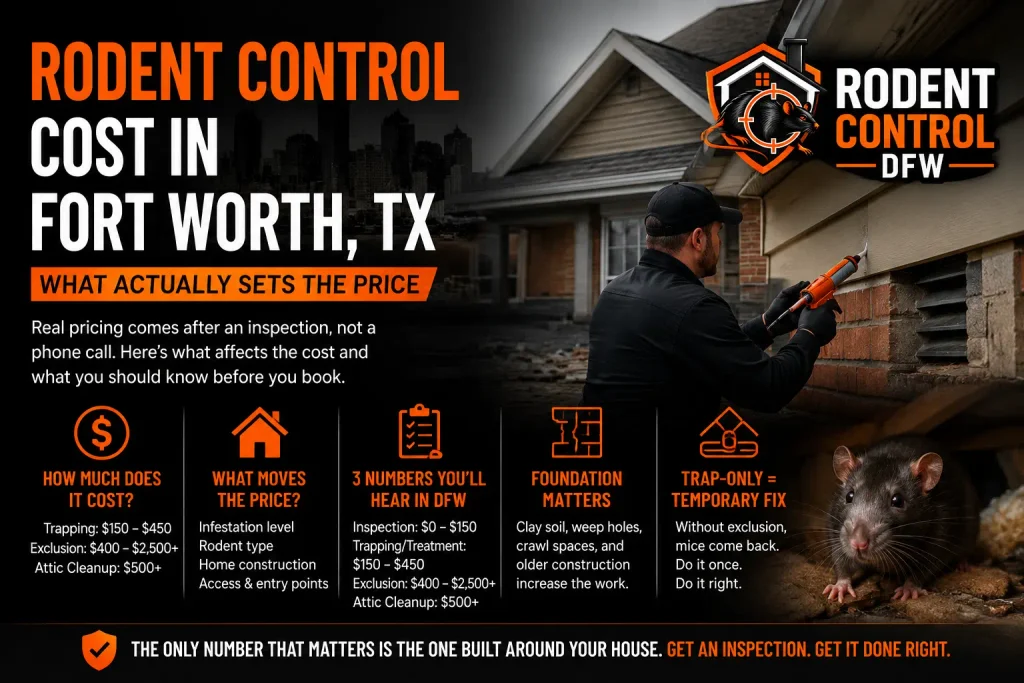
How Much Does Rodent Control Cost in Fort Worth?
Across DFW, a straightforward job runs somewhere between $150 and $450 for inspection and an initial trapping program, and a full exclusion job, sealing the entry points so the problem doesn’t come back, lands between $400 and $2,500 depending on the house. A heavy infestation with attic contamination can push past that. The only number that matters is the one built around your actual house, not a market average.
That range is wide on purpose. A slab-foundation house in a newer part of Fort Worth with two obvious gaps around a dryer vent is a different job than a pier-and-beam house near the Trinity River corridor with an open crawl space and a decade of unsealed weep holes. Both fall under “rodent control.” Neither costs the same amount to do right.
What Actually Moves the Price Up or Down
Three things drive most of the spread between a $200 job and a $2,000 one. The first is how far along the infestation already is. A handful of mice caught early is a short job. A colony that’s been breeding behind a wall for months means more traps, more visits, and more time before anyone should even think about sealing the openings, since sealing too early just locks the problem inside.
The second is which rodent you’ve got. Norway rats stay low and mean ground-level work around the foundation and slab. Roof rats climb fence lines and trees into the attic, so that job runs overhead, checking roofline gaps and vent screens instead of crawl space entry points. Mixed infestations, which aren’t rare in this area, mean pricing both approaches into one job instead of one or the other.
The third is the house itself. Square footage matters less than people assume. What actually drives cost is how many entry points a technician finds and how hard each one is to reach, a soffit forty feet up a two-story roofline costs more labor to seal than a ground-level weep hole. A crawl space adds scope a slab foundation never will. None of this shows up in a phone estimate. It shows up in a walkthrough.
The Three Numbers You’ll Hear Quoted in DFW
Most quotes across the metroplex break into three pieces, and knowing them going in makes it easier to tell whether a number you’re handed actually covers the job or just the first visit. Inspections run free to around $150 depending on the company. Trapping and initial treatment, the part that removes what’s already inside, typically lands in the $150 to $450 range for a standard residential job. Full exclusion, sealing every gap a rodent could use to get back in, runs $400 to $2,500 depending on the roofline and foundation type, and attic cleanup after a bad infestation is usually its own line, often $500 and up.
A quote that’s only the middle number, trapping without exclusion, isn’t wrong. It’s just half the job. Plenty of companies sell it that way, it’s the cheaper number to say out loud, and that gap is the reason a homeowner sees mice again eight weeks after paying for “rodent control” the first time.
Why an Older Fort Worth Foundation Changes the Math
This part of Texas sits on expansive clay soil that swells and shrinks with the weather, and slab foundations here develop hairline cracks over years in a way that houses on more stable ground don’t. Brick veneer construction adds weep holes at the base of the wall for drainage, and a lot of those go unscreened for decades. Both are built into how homes here were made, not damage from neglect, and both cost real labor to seal correctly.
Pier-and-beam homes, more common in Fort Worth’s older neighborhoods than in the newer suburbs ringing the city, add a crawl space to the job that a slab house simply doesn’t have. Sealing skirting gaps and plumbing penetrations under a raised foundation takes more time on a knee pad than most people picture when they hear “rodent control,” and that time shows up in the exclusion number, not the trapping one.
Fort Worth’s creek corridors and mature tree cover add pressure of their own. Roof rats use overhanging limbs as a bridge onto rooflines in neighborhoods with older trees, which is part of why two houses a few blocks apart can get different quotes even with similar square footage. One has a fence line running under a tree canopy straight to the attic vent. The other doesn’t.
Trap-Only Pricing Looks Cheaper Until You Call Back in Six Weeks
The lowest number you’ll hear in this market almost always belongs to a company that traps and leaves. It’s a real service, and it’s genuinely less work, which is exactly why it costs less. The gap is what happens after. Traps clear out what’s already inside a structure. They do nothing about the opening that let the first batch in, so the next mouse that finds the same gap gets the same easy access.
Priced against a single visit, exclusion looks like the more expensive option every time. Priced against a full year, a trap-only job that gets you a second call in two months usually costs more than doing the sealing work up front would have. That’s the math worth running before choosing the cheaper quote, not the sticker price by itself.
Why the Follow-Up Visit Shouldn’t Show Up as a Separate Line Item
A single treatment tells you rodents were there. It doesn’t confirm the exclusion held or that everything already inside is gone, and mice breed fast enough that a population can rebuild before anyone notices. A follow-up visit to check traps and confirm the sealed points are still sealed is part of what a real rodent control price is paying for.
Plenty of quotes leave that visit off the number entirely, then bill it separately if the customer calls back with new activity. Ask directly whether a follow-up is included before comparing two quotes side by side. A cheaper number that doesn’t include it isn’t actually cheaper once you add the visit back in.
Commercial Jobs Aren’t Just Bigger Numbers
A restaurant kitchen or warehouse costs more than a house, and a bigger building alone isn’t the reason. Commercial properties usually have more entry points to check across a bigger footprint, and food-service locations carry health inspection standards that shape where bait can go and how documentation gets handled. That planning happens before a technician starts work, not after, and it’s built into a commercial quote in a way a residential one never accounts for.
Treating a commercial job like a scaled-up house call is how a business ends up with a quote that looks reasonable and a scope that misses half of what a health inspector will actually check.
What Should Be In Writing Before You Agree to a Price
A quote worth trusting spells out what’s included, not just a total. That means the inspection findings in plain language, whether trapping and exclusion are both covered or only one, whether the follow-up visit is part of the price, and what happens if activity continues after the work is done. A number without those details attached is a placeholder, not a real quote.
Worth asking directly, what did the inspection actually find, and where. A technician who can point to specific gaps, a weep hole here, a vent screen there, is pricing your house. One who gives a number based on square footage alone is pricing a guess.
Why Rodent Control DFW Doesn’t Publish One Price List
Rodent Control DFW connects Fort Worth and DFW homeowners with vetted, licensed technicians rather than sending one crew to every job, so pricing depends on which technician takes the call and what their inspection turns up, not a flat rate set from an office. That’s the honest answer, not a dodge. A single published price list would either be too low to mean anything or padded to cover the widest job it might have to fit.
What stays consistent across every job dispatched through this site is the standard, not the number. Every technician is expected to inspect first, explain findings in plain language, and price trapping and exclusion together rather than selling the cheaper half. My co-founder, Noah Willson, has been through this pricing conversation more than 140 times across his own jobs, and I’ve run it for a decade before this company existed. Between the two of us, the spread between a small job and a large one is bigger than most homeowners expect walking in, and neither of us has ever seen a legitimate quote get built without someone standing in the attic first.
A Few Straight Answers
Does insurance cover rodent control? Almost never for the treatment itself. Some homeowner policies cover repair to damage rodents caused, wiring or insulation, but check your specific policy rather than assuming either way.
Is a phone estimate a real number? No. It’s a starting range at best. Treat anything given without an inspection as a placeholder, not a quote you can compare against another company’s actual walkthrough.
Why did my neighbor pay less for what sounds like the same problem? Different entry points, different roofline, different foundation type. Two houses on the same street rarely have the same job underneath a similar-sounding complaint.
Does a cheaper quote mean a worse job? Not automatically, but it’s worth asking exactly what’s included before assuming it’s the same scope at a better price. Trapping without exclusion is a real reason a quote comes in lower.
Getting a Real Number for Your Fort Worth Home
The only way to turn a range into an actual price is an inspection. If you’re hearing scratching in the attic or finding droppings and want to know what a job like yours would run, reach out and get a technician out to look at the property before deciding anything based on a number over the phone.