Rat Control in Fort Worth
A rat dropping the size of a raisin and a mouse dropping the size of a grain of rice are not the same problem wearing two different sizes. Rats need bigger openings, eat differently, nest differently, and depending on which species got in, they’re either burrowed under your foundation or climbing your roofline through a tree branch. Rodent Control DFW handles rat-specific inspection, exclusion, and trapping for homes and businesses across Fort Worth, built around figuring out which rat you actually have before deciding how to get rid of it.
Why Choose Us
A lot of companies treat “rat control” as one service with one method, whether it’s a Norway rat burrowed under a slab or a roof rat that climbed a fence line into the attic.
Those are two different animals with two different points of entry, and treating them the same way is how a job looks finished for three weeks and then isn’t. The technician identifies the species first, from droppings, gnaw marks, and where the activity is concentrated, and builds the exclusion plan around that instead of running a standard package.
Response on a rat call comes within 24 to 48 hours. The inspection happens before anything gets recommended, and nobody shows up with a trap and a sales pitch already decided.
Norway Rats vs Roof Rats: How to Tell Which One You Have
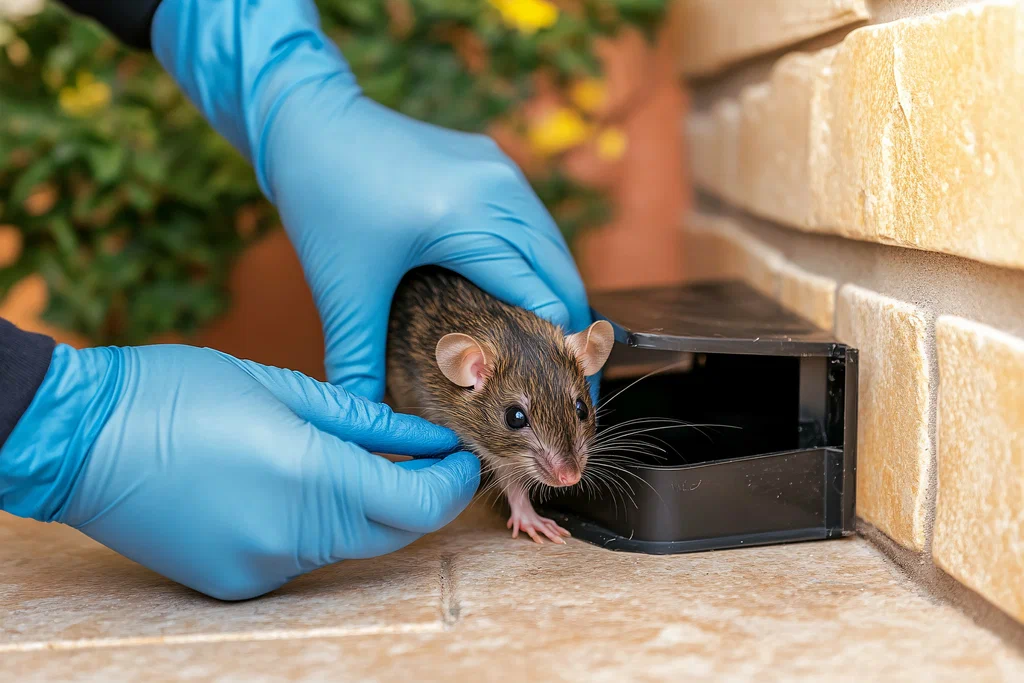
Fort Worth and the surrounding DFW area deal with two rat species, and they barely overlap in behavior. Norway rats are the heavier, ground-dwelling ones. They burrow near foundations, slab edges, and cluttered ground-level storage, and they’re strong enough swimmers to survive a soggy crawl space for days. Their droppings are blunt at both ends, roughly the size of a raisin, usually clustered near the burrow rather than scattered.
Roof rats are lighter, leaner, and built for climbing. They use fence lines, overhanging tree branches, and power lines to reach a roofline, then nest in attics, soffits, and eaves. Their droppings are pointed rather than blunt, and their gnaw marks tend to show up higher in a structure, around roof penetrations and attic framing, instead of at ground level.
A homeowner who calls in convinced they’ve got “a bigger mouse problem” is usually half right and half wrong. The size difference is real, but the location tells the actual story. Ground-level noise and burrows near the foundation point to Norway rats. Scratching in the attic or soffit, especially with nearby trees or a fence line running close to the roof, points to roof rats. Getting that identification wrong at the start means exclusion work goes to the wrong part of the house.
How Rats Get Into Fort Worth Homes
Rats need a bigger gap than mice, roughly the width of a quarter for an adult rat, but Fort Worth homes hand out that much space more often than people assume.
This region sits on expansive clay soil that swells and shrinks with the weather, which is a big part of why slab foundations here develop cracks and gaps that a house built on more stable ground wouldn’t get. Add brick veneer construction, which depends on weep holes at the base of the wall for drainage, and there’s a built-in ground-level entry path on a lot of Fort Worth homes before a rat even has to work for it.
Roof rats have their own set of doors. Tree limbs overhanging the roofline, fences that run close enough to touch the eaves, and gaps around roof penetrations, vent stacks, and chimney flashing all give a climbing rat a way in that a Norway rat would never use. Older neighborhoods with mature trees see more of this pattern than newer subdivisions with younger landscaping, which is part of why the same street can have very different rat pressure block to block.
Why Hardware Cloth Beats Foam and Caulk on Rats
Spray foam and caulk fail against rats for the same reason they fail against mice, just with a bigger mouth doing the chewing. A rat’s front teeth grow continuously, so a soft sealant slows it down for maybe a day.
The material that actually holds is galvanized hardware cloth, sized to the gap. Mouse-sized openings get sealed to a 1/4-inch mesh standard. On a rat-only opening, 1/2-inch mesh can hold, but on a mixed job where both species are active, sizing everything to the tighter 1/4-inch standard is the safer call rather than sealing a gap that only stops the bigger animal and leaves a mouse-sized door open.
Foam still gets used, but as a filler behind the hardware cloth, never as the barrier by itself.
What a Rat Control Job Actually Involves
A rat control visit in Fort Worth runs through four steps, and the order matters as much as the steps themselves.
- Species identification from droppings, gnaw marks, and activity location, to confirm whether the job is Norway rats, roof rats, or both.
- A full inspection of the relevant zone, ground-level foundation and crawl space for Norway rats, roofline and attic for roof rats, to map every entry point rather than the one that seems obvious.
- Exclusion work sealing every identified opening with galvanized hardware cloth sized to the gap, not foam or caulk alone.
- Trap placement along confirmed travel paths, followed by a monitoring period to confirm activity has actually stopped before the job gets closed out.
Ground-Level Work for Norway Rats
Norway rat jobs live at the bottom of the house. That means checking the slab perimeter for cracks that widened as the clay soil shifted, foundation vents with damaged or missing screens, gaps where a garage door seal has worn down, and any burrow activity in mulch beds or cluttered storage pushed up against the exterior wall. A Norway rat doesn’t need to climb anything. It just needs one soft spot at ground level and a reason to stay, usually food access or a dry place to nest.
Because Norway rats can tread water for days, a crawl space with standing moisture after rain isn’t a deterrent the way it would be for most pests. If anything, it can hold a burrow in place longer than a dry one would.
Roofline and Attic Work for Roof Rats
Roof rat jobs live at the top. The technician checks where tree limbs or fence lines give a rat a bridge to the roof, then works the roofline itself, vent stacks, chimney flashing, soffit returns, and any gap in the fascia board where wood has started to rot. Trimming a tree back from the roofline is often part of the recommendation, not because it kills the rat problem on its own, but because it removes the easiest route back in after exclusion work is done.
Attic activity from roof rats tends to concentrate near the entry point rather than spreading evenly, so trap placement follows the gnaw marks and droppings instead of getting scattered across the whole attic on a guess.
Why Trapping and Bait Alone Usually Fail on Rats
Snap traps and bait stations work on rats the same way they work on mice, meaning they’re useful tools and an incomplete plan by themselves. A rat population being trapped without its entry points sealed just gets replaced from outside as fast as it’s removed.
Bait carries an extra risk with a larger animal: a rat that dies from bait inside a wall cavity or under a slab creates an odor problem that’s harder to deal with, and lasts longer, than the equivalent issue with a mouse, simply because there’s more of it.
That’s the reason exclusion work comes before bait gets considered as anything more than a selective tool, not the default plan.
Health and Property Risks Specific to Rats
Rats carry disease risk that goes beyond what a mouse typically brings into a house. Norway rats and roof rats can both carry leptospirosis, spread through urine contact with water or damp surfaces, along with salmonella risk from droppings in food storage areas.
On the property side, a rat’s teeth do more damage per bite than a mouse’s, and a rat nesting in an attic or wall cavity for weeks can chew through wiring insulation, a documented cause of electrical shorts, and compromise more insulation than a mouse infestation typically would given the size difference.
None of this is a reason to panic. It’s the reason a rat sighting is worth a real inspection rather than a wait-and-see approach.
Why Rat Activity Increases in Fort Worth Neighborhoods
Older neighborhoods across Fort Worth and Arlington see more consistent rat pressure than newer construction, and it comes down to a few compounding factors rather than one cause. Aging weep holes without vent covers give Norway rats a ground-level door.
Mature trees and fences running close to rooflines give roof rats a climbing path that a newer subdivision, with younger landscaping, mostly doesn’t offer yet. Expansive clay soil adds foundation movement on top of both of those, opening gaps that weren’t there when the house was built.
None of these factors show up on a listing sheet, but they show up in a walk-through, which is part of why the inspection covers the whole exterior instead of just the spot where the noise was heard.
Follow-Up Verification Visits
A single treatment tells you rats were active. It doesn’t confirm the exclusion work held or that every rat inside the structure is gone, especially with roof rats that can keep finding new gaps near a roofline that wasn’t fully checked the first time.
A follow-up visit is part of the job, included rather than billed separately, where the technician checks traps, looks for new activity, and confirms the sealed points are still sealed.
If something’s still moving, that gets handled then. If it’s clear, that’s when the job is actually finished, not on the day the first traps went down.
Residential and Commercial Rat Control
Rodent Control DFW takes on house calls and commercial properties across Fort Worth and the surrounding DFW area, and the inspection and exclusion approach stays the same either way. What changes is scale. A commercial kitchen or warehouse usually has more entry points to check, more food storage to account for, and its own compliance concerns that shape how the job gets scheduled and documented, rather than getting treated as a bigger version of a house call.
Frequently Asked Questions
How do I know if it's rats and not mice?
Droppings are the fastest tell. Rat droppings run about the size of a raisin and are blunt or pointed depending on species. Mouse droppings are closer to a grain of rice. If you’re not sure, describe what you’re seeing when you reach out and the technician can narrow it down before the visit.
Do you treat Norway rats and roof rats the same way?
No. Norway rats get ground-level exclusion around the foundation and slab. Roof rats get roofline and attic work. A mixed infestation gets both.
How fast can someone come out for a rat problem?
Within 24 to 48 hours of a request coming in.
Do you use poison as the main method?
No. A rat that dies from bait inside a wall or under a slab creates an odor problem that’s worse than the original issue. Exclusion and trapping are the primary method, with bait used selectively.
Will one visit fully solve a rat problem?
Usually not. A follow-up visit confirms the sealed points are holding and no activity remains, especially on a job that had been building for a while before the first visit.
Get in Touch
If you’re hearing movement at ground level or in the attic, finding raisin-sized droppings, or a fence line or tree branch runs close enough to your roof to give a rat a bridge, reach out and get a technician out to identify the species and the actual entry point. Schedule a rat inspection for your Fort Worth or DFW home or business.
Contact Rodent Control DFW
Have questions or need help with our services? Get in touch with our team today. We’re here to answer your questions, provide expert guidance, and help you find the right solution for your needs
- hello@rodentcontroldfw.com
- Rushing River Dr Fort Worth, TX 76118 United States